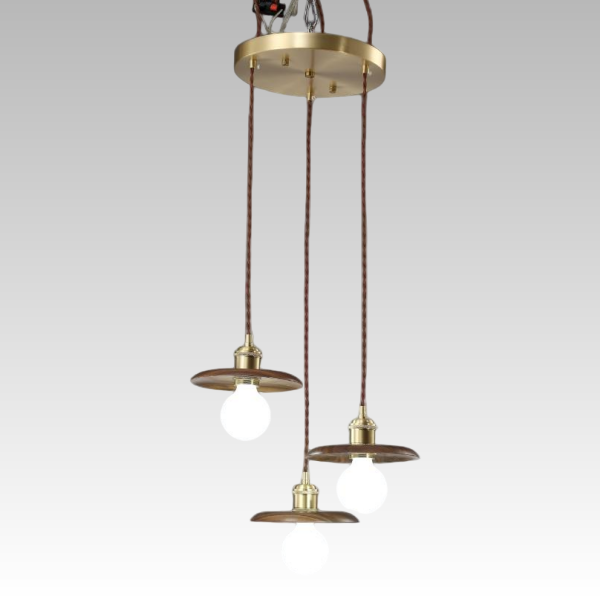
Dining Room Chandelier Size: Formulas, Height Rules & Height-by-Ceiling Guide
Of all the questions buyers send us, one comes up more than any other: "How big a chandelier do I need for this dining room?"
It sounds like a simple question. In practice, most people get it wrong — not because they lack taste, but because the internet gives them a single half-formula ("diameter = table width minus 12 inches") that only works for one specific table shape, ignores ceiling height entirely, and says nothing about what happens when the fixture is too heavy for the junction box or too tall for a low ceiling.
Getting the size wrong is expensive. An oversized chandelier makes a dining room feel like it is closing in. An undersized one looks apologetic, like a candle floating over a banquet table. And a fixture hung at the wrong height will be either bumped into by every guest who stands up, or so high it lights the ceiling instead of the plates.
This guide gives you the actual arithmetic, structured in the order you should apply it: diameter first, then hanging height, then the vertical sizing rules most guides skip entirely. We included the awkward cases too — low ceilings, open-plan rooms, rectangular tables, sloped ceilings — because those are the situations where buyers usually end up making an expensive mistake.
Step One: Determine the Diameter
There are two formulas, and knowing which one applies to your table is the whole trick.
For a round or square table, use the table-width method. Measure the width of your table, then subtract roughly 12 inches (30 cm). That number is your ideal chandelier diameter. A 48-inch round table, for example, calls for a fixture around 36 inches across. The logic is simple: the chandelier should sit comfortably inside the table's footprint when viewed from above, leaving room at the edges so diners are not looking around it.
For a long rectangular table, the table-width method will give you an absurdly large result. Instead, divide the table length by the number of fixtures you plan to hang, and size each fixture to roughly one-third of that segment. Practically, this means a table under about 5 feet (1.5 m) usually takes one chandelier, while anything longer reads better with two or three smaller fixtures on a common canopy, or a linear fixture running along the table's axis.
For a room-based cross-check (useful when the buyer does not yet own the table), add the room's length and width in feet, and treat the sum as the maximum diameter in inches. A 12 by 16 foot dining room gives you a ceiling of 28 inches — a useful sanity check, because it prevents the "table formula said 48 inches" outcome in a room that cannot possibly carry a four-foot fixture.
Two subtleties worth knowing. First, transparent and airy designs — open metal frames, thin wood slats, glass — read as visually lighter than their measurements suggest, so you can stretch them slightly beyond the formula. Solid, dense designs should stay at or under the calculated size. Second, sightlines matter more than numbers: stand at the doorway where guests enter and confirm the chandelier does not block the view of the table's centerpiece or, in an open plan, of the room beyond.
Step Two: Set the Hanging Height
The standard rule for a dining chandelier is that the bottom edge of the fixture should sit 30 to 36 inches (76–91 cm) above the tabletop. This is the range that lets seated guests see each other across the table while keeping the light close enough to actually illuminate the food and faces rather than flooding the room.
Within that range, adjust by ceiling height and by the fixture's own design:
A standard 8-foot (2.4 m) ceiling sits comfortably in the middle of the range, around 32–34 inches above the table.
A 9-foot or higher ceiling allows you to hang at 36 inches or slightly above, which keeps the fixture visually connected to the table rather than lost in the volume above it.
If your ceiling is 10 feet or taller, the extra airspace above the table means you should raise the fixture a little and, often, increase its size — a tall room makes a modest chandelier look smaller than it is.
Then there is the clearance rule that saves knees and heads: in any room where people walk beneath the fixture — a dining room open to a hallway, a kitchen island, an entryway — the bottom of the chandelier should be at least 78 inches (about 2 m) above the floor. If these two rules conflict, the floor clearance wins. A fixture hung slightly higher than ideal over the table is a minor aesthetic compromise; a fixture that people walk into is a functional failure that ends with the fixture coming down.
One more practical note that most guides omit: measure to the bottom of the lowest hanging element, not to the canopy or the body. Candle-style fixtures with dangling crystals or wood drops often hang several inches lower than the main body suggests, and that is the measurement that determines whether a guest's forehead meets it.
Step Three: Vertical Sizing — The Part Everyone Skips
Horizontal size gets all the attention, but the vertical proportion is what separates a professionally installed room from a DIY one.
The rule of thumb: the chandelier's total height (body plus any chain or rod) should be roughly 2.5 to 3 inches for every foot of ceiling height. An 8-foot ceiling therefore supports a fixture about 20 to 24 inches tall; a 10-foot ceiling supports one closer to 25 to 30 inches. If your fixture comes in noticeably shorter than this, it will look undersized even if the diameter is correct; if it is much taller, it will crowd the ceiling.
For sloped or vaulted ceilings, ignore the low side and measure at the highest point where the fixture will actually hang, then add enough chain or rod length to keep the bottom edge at the correct height above the table. Also check the ceiling's structural reality before ordering: a chandelier that weighs more than about 35 pounds (16 kg) generally needs a ceiling-support rated junction box or a brace installed by an electrician. This is the single most common installation-day surprise, and it is far cheaper to discover before the fixture ships than after.
Room-by-Room Adjustments
Dining rooms follow the formulas above most strictly — the table gives you a fixed reference point, and the fixture's job is to define the dining zone.
Living rooms have no table to measure against, so the room-dimension method dominates: length plus width in feet equals diameter in inches. For seating groups arranged around a coffee table, the chandelier's diameter should cover the coffee table plus roughly half its width on each side. Hanging height for a living room fixture is typically 7 to 7.5 feet above the floor for rooms with 8- to 9-foot ceilings, higher for double-height spaces.
Open-plan kitchen and dining areas need the fixture centered over the dining table, not over the room's geometric center. If the table is off-center, the chandelier follows the table — this is a case where symmetry with the architecture loses to function.
Small dining nooks (under 100 square feet) do not need to be abandoned to flush mounts. A small pendant or a compact chandelier of 18 to 22 inches works well over a 36-inch table, provided the ceiling height allows the clearance. The key is keeping the visual weight low — open frames, light wood, thin profiles — so the fixture contributes air rather than bulk.
Five Mistakes That Ruin an Otherwise Good Choice
Sizing from the room instead of the table. The most common error. In a large room with a modest table, the room formula predicts a chandelier that will dwarf the dining setup.
Ignoring the fixture's height in favor of its diameter. A wide but shallow fixture over a tall ceiling looks like a plate stuck to the sky. Buyers who focus only on diameter frequently discover this after installation.
Forgetting the dimmer. A dining chandelier that can only run at full brightness is a missed opportunity; the same fixture at 30 percent output transforms a dinner party. Dimmability is a specification you should confirm before ordering, not an accessory to add later.
Choosing a finish that fights the wood. A dining room with walnut furniture and warm oak flooring will look discordant with a cool chrome fixture. Solid wood fixtures in walnut or ash tones tend to settle a room's palette, which is one reason wooden chandeliers remain a durable choice in dining spaces.
Skipping the mock-up. Before purchasing, cut a piece of cardboard to your calculated diameter and tape it to the ceiling for a day. It takes twenty minutes and prevents nearly all of the regrets described above. If the cardboard looks too big, it is — the real fixture will look bigger.
What Color Rendering Does to a Dining Room
Size determines whether the fixture fits the room. Color rendering determines whether the room's food looks edible.
This is why the number to ask for on a dining room fixture is the CRI, and specifically the R9 value. Standard LEDs typically sit at CRI 70–80 and render reds poorly; under that light, a rare steak turns gray-brown, tomatoes look muted, and a carefully plated dessert reads as beige. Full spectrum sources at CRI 90 and above — and especially CRI 95+ with a healthy R9 — keep food colors saturated and appetizing.
Color temperature matters almost as much. Around 2700K to 3000K is the sweet spot for dining: warm enough to flatter skin tones and food, cool enough not to turn the room orange. Our dining chandelier line pairs walnut and ash solid wood with full spectrum LED sources, three-color switching, and continuous dimming precisely so that a single fixture can move from a bright family dinner to a low, intimate dinner party without changing the plate's appearance for the worse.
If you want to see how a wooden chandelier behaves in a real dining room before committing to dimensions, our chandelier collection includes models with published dimensions and suspension ranges for each size — useful as reference points even if you are still at the cardboard mock-up stage. And if you are also rethinking the perimeter lighting in the room, the sizing logic for wooden wall lights works on entirely different principles, since those fixtures are about layering and shadow rather than central illumination.
Frequently Asked Questions
How big should a chandelier be for an 8-foot ceiling in a dining room?Diameter is determined by the table, not the ceiling: table width minus 12 inches for round tables, or one-third of each table segment for long rectangular tables. For vertical proportion, an 8-foot ceiling suits a fixture about 20–24 inches tall, hung with its lowest point 30–34 inches above the tabletop.
Can a chandelier be too big for a dining room?Yes, and it is the more common error. Use the room-dimension check — length plus width in feet, capped in inches — to prevent an oversized fixture. In open-plan spaces, remember that a large chandelier competing with a kitchen island reads as visual clutter rather than drama.
How high should a chandelier hang above a dining table?30 to 36 inches from the tabletop to the lowest point of the fixture. The floor clearance rule overrides it: never hang lower than 78 inches above the floor in any area where people walk.
Do two chandeliers over a long table need to be the same size?They can differ, but they should share the same design vocabulary and hanging height, and their combined proportions should still respect the one-third rule for each segment. Matching sizes is the safer choice when the table is symmetrical.
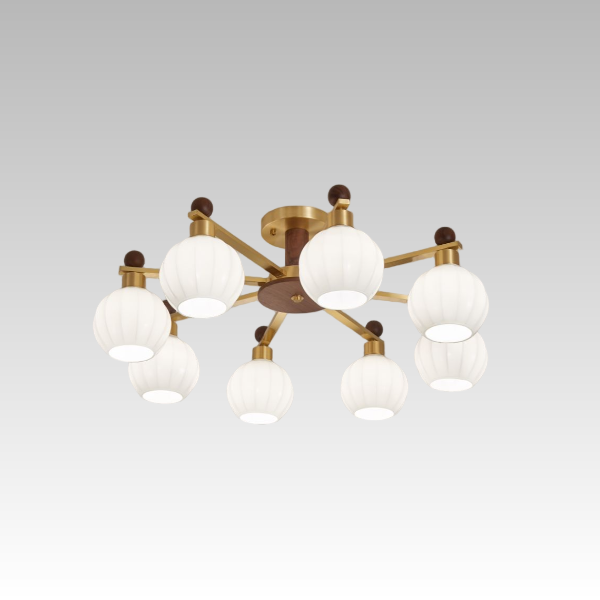
Is a flush mount acceptable over a dining table?In low-ceilinged rooms, yes — a flush mount or semi-flush is often the only sensible option. Choose one with a wide spread and high CRI so it still lights the table properly, and consider adding dimming and a warm color temperature to keep the room comfortable at night.